Why Material Selection Matters in Industrial Inflatable Systems
By Justin Russell •
Why Material Selection Matters in Industrial Inflatable Systems
When people think about industrial inflatable systems, they often focus on one thing first:
“How strong is the material?”
In reality, material selection is far more complicated than simply choosing the fabric with the highest tensile strength on a datasheet.
Industrial inflatable systems operate in harsh environments where:
- heat,
- abrasion,
- chemicals,
- UV exposure,
- contamination,
- repeated handling,
- and difficult installation conditions
all influence long-term performance.
A material that looks impressive on paper can perform very poorly in real industrial conditions.
At PolyFusion WA, material selection is approached from a practical perspective:
Before choosing an inflatable solution, we ask how will the system actually behave in the field?
Why Isn’t The “Strongest” Material Always The Best Choice?
One of the biggest mistakes people make when selecting materials for industrial inflatable systems is focusing too heavily on datasheets.
The strongest material on paper may:
- weld poorly,
- become too stiff,
- crack during handling,
- be difficult to repair,
- pack poorly,
- or perform badly under repeated use.
Industrial inflatable systems are always a compromise between:
- durability,
- flexibility,
- weldability,
- processability,
- repairability,
- packed size,
- handling,
- transportability,
- operating environment,
- and cost.
There is no perfect material for every application.
The material that handles heat best may weld poorly.
The strongest material may be too rigid.
The lightest material may wear out faster.
The most chemically resistant material may become prohibitively expensive.
Anyone claiming one material solves every industrial application probably has not spent much time working in real operating environments.
Why Does Processability Matter So Much?
One area that is often overlooked outside manufacturing environments is processability.
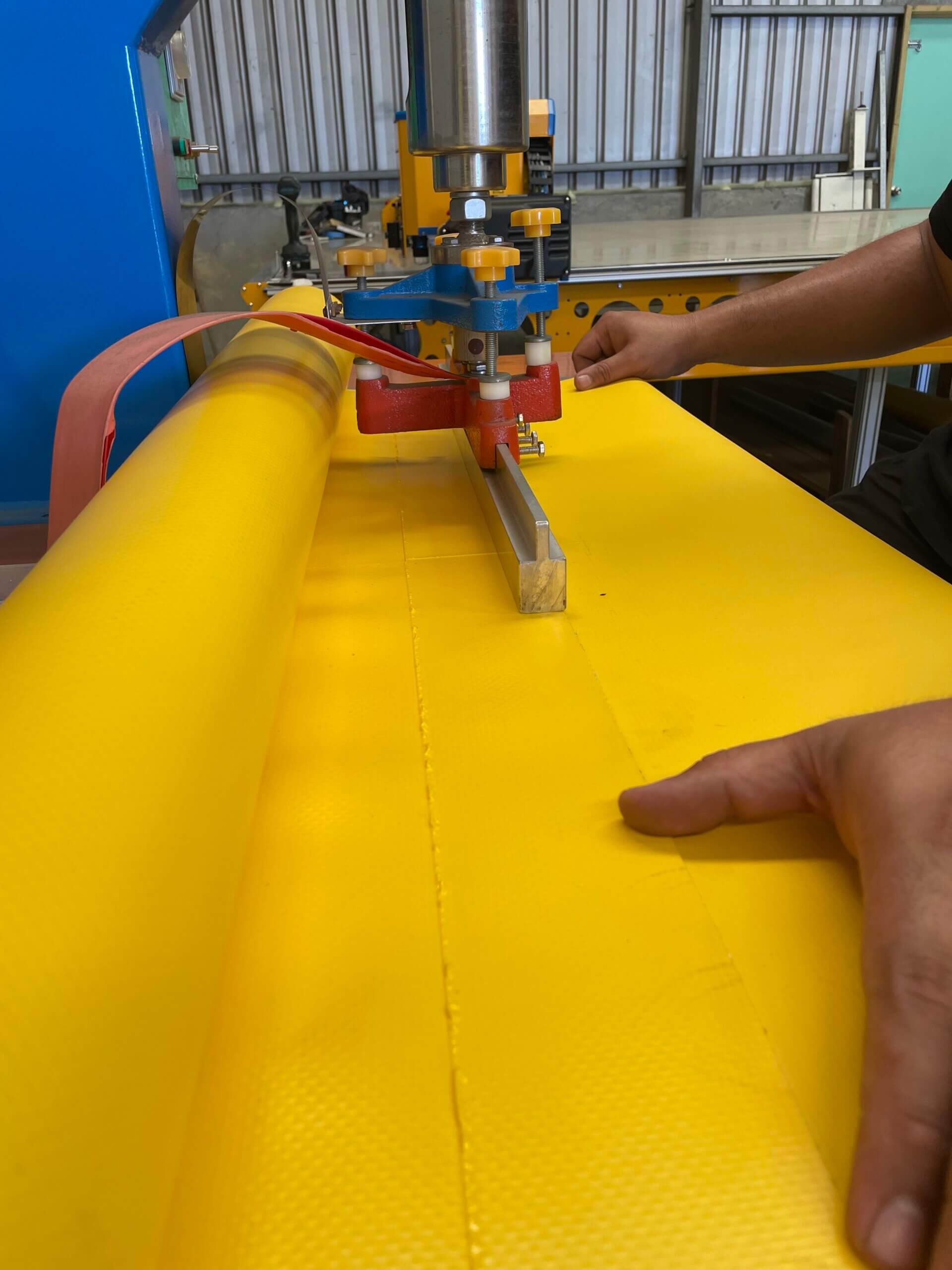
A material may technically be weldable, but that does not necessarily mean it behaves well during production.
Datasheets may specify:
- RF weldable,
- hot air weldable,
…but they rarely explain how consistently the material performs during actual manufacturing.
Processability affects:
- seam consistency,
- manufacturing repeatability,
- dimensional stability,
- repairability,
- production speed,
- and long-term reliability.
A theoretically strong material that behaves inconsistently during fabrication can quickly become a reliability problem.
In industrial inflatable systems, the seams are often just as important as the fabric itself.
An inflatable is only as reliable as its welds.
What Environmental Factors Damage Inflatable Systems Most?
People often assume industrial inflatable systems fail because of dramatic overload events.
In reality, long-term degradation is usually caused by environmental exposure and poor aftercare.
Some of the biggest contributors to premature deterioration are:
- chemical contamination,
- UV exposure,
- hydrolysis,
- abrasion,
- poor storage,
- contamination left on surfaces after use,
- and repeated handling damage.
Many systems are packed away after use covered in:
- concentrate,
- mud,
- grease,
- chemicals,
- or mineral residues.
Over time, these substances can interact with the PVC coating systems and accelerate deterioration.
Material tradeoffs also become important.
For example, some materials are designed for improved underground performance but may sacrifice UV resistance to achieve gains in other properties.
If those systems are then stored incorrectly in direct sunlight, material life can reduce dramatically.
Why Do Some Materials Perform Worse Than Their Datasheets Suggest?
Another reality rarely discussed openly is that published material specifications do not always perfectly reflect real-world performance.
We have seen third-party testing results where materials performed up to 20% below advertised tensile strengths.
Datasheet values are often closer to best-case manufacturing results rather than guaranteed real-world performance across every batch.
Small changes in manufacturing processes can also have major consequences.
During the COVID period, we observed FRAS materials supplied from overseas that suddenly exhibited dramatically reduced adhesion strength. The materials welded normally, but the bond strength was only a fraction of what it should have been.
When questioned, the supplier later admitted they had substituted a chemical during production due to shortages.
We have also seen situations where manufacturing procedures promoted publicly by suppliers were not actually being followed consistently during production.
Industrial manufacturing depends heavily on:
- process control,
- consistency,
- supplier trust,
- and quality assurance.
Small unnoticed changes can create major long-term reliability problems.
Why Does Geometry Matter So Much?
Material selection alone does not determine inflatable performance.
Geometry often matters just as much.
Small changes in shape can dramatically affect:
- load paths,
- seam loading,
- deformation behaviour,
- stress concentrations,
- fatigue life,
- and long-term durability.
In many cases, improving geometry provides larger durability gains than simply increasing material strength.
A badly designed shape will destroy even good materials.
One of the major advantages of inflatable systems is their ability to conform to irregular or uneven surfaces that rigid systems struggle to accommodate.
That flexibility becomes extremely valuable in industrial environments.
Why Are Repeat-Use Systems Different?
A one-off inflatable system only needs to survive the immediate task.
A repeat-use industrial system must survive:
- transport,
- handling,
- contamination,
- repeated inflation cycles,
- storage,
- repairs,
- setup,
- removal,
- and operators who were never involved in the original design.
Reusable systems require:
- larger design margins,
- better wear management,
- practical repairability,
- and much greater attention to handling conditions.
Material choice heavily affects repairability.
We once worked with a material that performed exceptionally well operationally, however exposed scrims would absorb water, making field repair extremely difficult.
Real industrial durability extends far beyond initial performance.
What Do Harsh Industrial Environments Teach You About Engineering?
Industrial environments expose weak assumptions very quickly.
Most failures do not happen because the maths was wrong.
They happen because reality is messy.
Sharp edges.
Heat.
Rushed installs.
Contamination.
Uneven surfaces.
Poor storage.
Unexpected loading.
Operators dragging systems instead of lifting them.
Industrial durability is really about surviving imperfect conditions.
That is why practical installation and operational experience matters so much when designing industrial inflatable systems.
Built For Real Operating Conditions
At PolyFusion WA, material selection is approached practically.
Not just:
“What performs best in laboratory conditions?”
But:
“What will survive real operating environments repeatedly?”
Because ultimately, industrial inflatable systems succeed or fail in the field — not on a datasheet.